A well-written story is not necessarily a good TAT response.
Many SSB aspirants practise writing stories that have everything they believe a “good” story should contain: a positive hero, a problem, quick action and a successful ending. The story may sound impressive and grammatically correct, yet it may still reveal very little about the candidate who wrote it.
This happens because the Thematic Apperception Test (TAT) in the SSB psychological assessment is not primarily a test of creative writing. The pictures provide a situation through which candidates express their perceptions, thoughts, reactions and approach to situations.
The important question, therefore, is not simply:
“Is this a good story?”
It is:
“Does this response naturally reflect the way I perceive and respond to a situation?”
What Happens in TAT?
During TAT, candidates are shown a series of pictures and asked to develop stories around them within a limited time. Typically, the response develops around the situation perceived in the picture, the people involved, what led to the situation, what happens next and how events progress.
Because candidates work under time pressure and interpret relatively open situations, their responses may provide psychological material for assessment.
This is also why memorising a collection of “ideal TAT stories” can defeat the purpose of preparation.
The Problem With the “Perfect Hero”
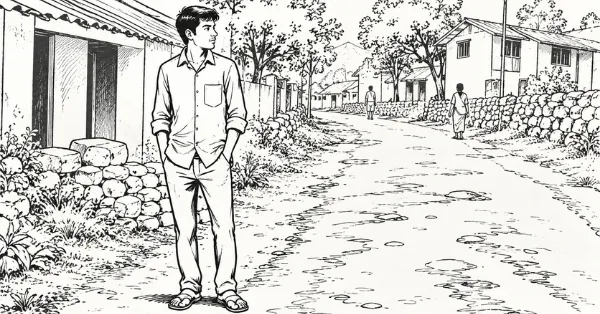
Consider a picture showing a young man standing near a village road.
A heavily practised candidate may immediately write:
Rahul was a highly motivated young man. He noticed that the road in his village was damaged. He gathered the villagers, contacted the authorities, arranged resources, supervised the work and successfully got the road repaired.
There is nothing inherently wrong with this story.
The problem begins when virtually every picture produces the same extraordinary protagonist.
- He organises a blood donation camp.
- He catches criminals.
- He saves someone from drowning.
- He transforms his village.
- He leads every group.
- He solves every emergency.
Individually, these stories may sound positive. Collectively, however, they can start looking constructed rather than spontaneous.
TAT preparation should not become a competition to create the most heroic protagonist.
1. You Are Trying to Impress Instead of Respond
One common mistake is asking:
“What story will impress the psychologist?”
That question can push candidates towards artificial responses.
Instead of interpreting the picture naturally, they begin inserting leadership, bravery, social service or achievement into every situation.
A candidate may consequently produce a story that sounds admirable but has little connection with the stimulus or with their natural thinking.
Positivity alone does not make a response psychologically meaningful.
2. Your Hero Is Unrealistically Capable
Candidates sometimes make their protagonist:
- solve problems far beyond their role or resources,
- take authority they realistically would not possess,
- achieve complex outcomes almost instantly,
- handle every situation without difficulty,
- possess expertise without any explanation.
Effective action should make sense within the circumstances of the story.
A 19-year-old student responding intelligently within his available resources can appear far more natural than a 19-year-old who somehow behaves like a district magistrate, military commander, doctor and disaster-management specialist depending on the picture.
3. You Are Forcing an OLQ Into Every Story
Aspirants learn about Officer Like Qualities and then sometimes try to deliberately display them.
Picture shows a group?
Show leadership.
Picture shows an accident?
Show courage.
Picture shows a difficult situation?
Show determination.
This can turn TAT into a formula.
OLQs are not keywords that need to be inserted into a story. Relevant qualities may emerge through the character’s thinking, decisions, relationships and actions.
There is an important difference between demonstrating behaviour naturally and manufacturing behaviour because you think the assessor wants to see it.
4. Your Story Has Action but No Thinking
Some candidates focus so much on action that their protagonist moves from one task to another mechanically.
He saw the problem.
He gathered people.
He made a plan.
He contacted officials.
He completed the task.
The end.
But why did the protagonist choose that approach? What information did they have? Were the actions proportionate to the situation?
A believable story generally has a logical relationship between:
Situation → Thought → Decision → Action → Outcome
When those connections are missing, even an action-packed story can feel superficial.
5. Every Story Has the Same Personality
This is another consequence of excessive practice.
Regardless of the picture, the protagonist is always:
confident + commanding + socially active + successful + fearless.
Real people respond differently to different situations.
Sometimes initiative is appropriate.
Sometimes cooperation matters more.
Sometimes careful planning is required.
Sometimes the sensible decision is to seek expert assistance rather than attempting to solve everything personally.
Different situations allow different aspects of personality to emerge.
6. You Have Memorised Themes
Practising TAT is useful.
Memorising stories is different.
Suppose you have prepared standard stories around:
village development, blood donation, cleanliness drive, sports competition, road safety and disaster relief.
You may gradually start trying to fit unfamiliar pictures into one of these prepared themes.
The process becomes:
Picture → Find matching memorised story → Modify details → Write
rather than:
Picture → Observe → Interpret → Think → Respond
That difference matters.
7. The Story Doesn’t Match the Picture
Sometimes the candidate has written a genuinely impressive story, but the visual cues do not reasonably support the interpretation.
For example, a simple picture of two people talking becomes an elaborate rescue operation because the candidate wants to demonstrate courage.
Your imagination has room to operate in TAT, but the story should still emerge plausibly from what you perceive in the picture.
Don’t ignore the stimulus simply to reach a predetermined story.
8. Your TAT and the Rest of Your Responses Don’t Sit Naturally Together
This is one of the reasons candidates should be cautious about manufacturing an “ideal personality.”
TAT is not the entire SSB.
The psychological assessment includes other techniques such as WAT, SRT and Self Description, while the broader SSB process also provides observations through GTO tasks and the interview.
Trying to create an artificial version of yourself becomes increasingly difficult when you have to sustain it across numerous responses and situations.
The goal should therefore not be:
“How do I show the perfect personality?”
A healthier preparation question is:
“How can I understand myself better and respond naturally, practically and consistently?”
What Makes a Better TAT Response?
There is no universal template capable of producing the “correct” TAT story.
However, candidates can work on several fundamentals.
Observe Before You Assume
Look carefully at the picture. Identify the central situation before building an elaborate narrative around it.
Keep the Situation Plausible
Your protagonist’s age, role, resources and actions should broadly make sense together.
Let Action Follow Thought
Don’t add activities merely to make the character appear dynamic. Actions should have a reason.
Don’t Fear Ordinary Situations
Every story does not require a crisis.
Studying for an examination, organising an activity, resolving a practical problem, completing a project or helping a group achieve something can provide perfectly meaningful situations.
Practise Thinking, Not Templates
Practice should help you become quicker at observing situations, organising thoughts and expressing them clearly within the available time.
It should not create a library of stories that you reproduce during the test.
Can You Prepare for TAT Then?
Yes, but preparation needs to be understood correctly.
You can improve your:
- observation,
- clarity of thought,
- speed of expression,
- ability to structure a situation,
- self-awareness,
- general awareness,
- and ability to respond practically under time pressure.
You can also examine recurring problems in your responses with appropriate guidance.
What you should be cautious about is attempting to learn a supposed collection of “recommended TAT stories.”
There is no magic story that guarantees recommendation.
A Simple Test for Your Next TAT Story
After writing a practice story, don’t only ask:
“Was my story positive?”
Ask:
Did I interpret the picture naturally?
Are the protagonist’s actions realistic?
Does the character actually have the resources to do what I wrote?
Did the solution emerge logically from the problem?
Did I force leadership or heroism where it wasn’t required?
Would I genuinely consider such an approach in a comparable situation?
These questions make TAT practice much more valuable than simply comparing your story with somebody else’s model answer.
The Bigger Lesson
The purpose of SSB preparation should not be to manufacture an ideal candidate for five days.
If your TAT responses repeatedly expose weak planning, limited awareness, unrealistic problem solving or difficulty expressing ideas, simply learning to write more impressive stories may hide the symptom without addressing the underlying issue.
That is where meaningful preparation begins.
Don’t only i