
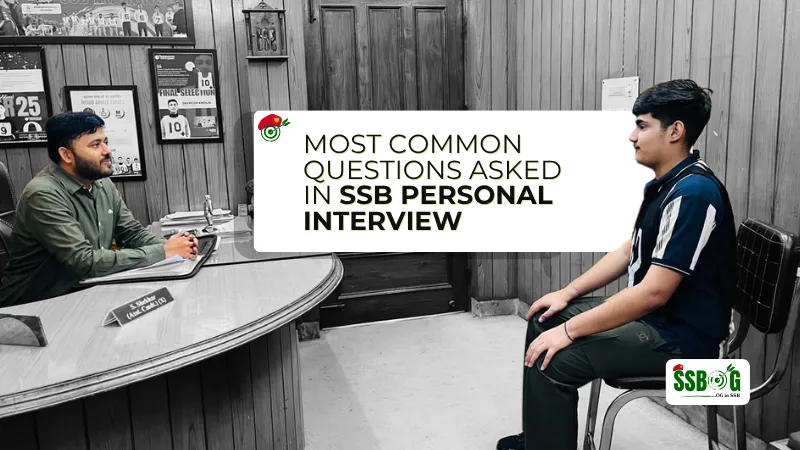
Most Common Questions Asked in SSB Personal Interview: What the Interviewing Officer Wants to Understand

Most Common Questions Asked in SSB Personal Interview: What the Interviewing Officer Wants to Understand

Almost every SSB aspirant wonders about the same thing before entering the interview room.

“What questions will they ask me?”

The search for a fixed list is understandable. Knowing the pattern creates a sense of control when you are about to sit across from an experienced Interviewing Officer.

But the SSB Personal Interview is not built around difficult or unusual questions. It is built around understanding the person answering them.

A simple question about school may reveal how you handle responsibility. A discussion about your friends may show how you function in a group. A question about failure may reveal whether you accept mistakes or quietly shift the blame.

This is why candidates who memorise answers often become uncomfortable when the conversation changes direction. Their prepared answer may sound smooth, but the follow-up questions require real reflection.

Understanding the most common questions asked in SSB Personal Interview is useful. Memorising polished replies is not.

What Is the SSB Personal Interview Designed to Assess?

The Personal Interview is one part of a wider assessment process.

The Interviewing Officer knows that candidates come from different schools, families, financial backgrounds, and educational environments.

The aim is not simply to compare achievements.

The officer is trying to understand:

  • How you think.
  • How you make decisions.
  • Whether your actions support your claims.
  • How well you know yourself.
  • How you respond when questioned further.
  • Whether your personality appears consistent across different areas of life.

Most questions are ordinary because ordinary experiences often reveal genuine behaviour more clearly than dramatic ones.

Why SSB Interview Questions Feel Personal

Unlike a written examination, the SSB interview revolves around your own life.

That naturally makes many candidates uncomfortable.

Questions about parents, friends, habits, weaknesses, failures, responsibilities, and relationships do not have textbook answers.

The Interviewing Officer is not expecting a perfect life.

The officer is trying to understand whether you can discuss your experiences honestly, calmly, and without creating an artificial version of yourself.

Candidates who become defensive or try to appear ideal often make the conversation more difficult than it needs to be.

Most Common Questions Asked in SSB Personal Interview


Questions About Yourself

These questions usually help the Interviewing Officer begin the conversation and understand how you see yourself.

Common questions include:

  • Tell me about yourself.
  • How would you describe yourself in a few words?
  • How would your parents describe you?
  • What do your friends think about you?
  • What are your strengths?
  • What are the areas you want to improve?
  • What changes have you noticed in yourself over the past few years?

What the Interviewing Officer Observes

The officer is unlikely to be impressed merely by positive adjectives.

The focus is more likely to be on:

  • Whether your description is balanced.
  • Whether your examples support your claims.
  • Whether you appear self-aware.
  • Whether your answers match what you have written in the Personal Information Questionnaire.

A candidate who says, “I am responsible,” may immediately be asked to describe a responsibility handled recently.

The example matters more than the label.

Questions About Family Background

Family-related questions often occupy an important part of the interview.

Typical questions include:

  • Tell me about your parents.
  • What does your father do?
  • What does your mother do?
  • What are your parents’ strengths and weaknesses?
  • Who are you closest to in your family?
  • How is your relationship with your siblings?
  • What responsibilities do you handle at home?
  • How does your family make important decisions?
  • Have you ever disagreed with your parents?

Why These Questions Matter

Family discussions may reveal:

  • Emotional maturity.
  • Respect for others.
  • Sense of responsibility.
  • Awareness of your immediate environment.
  • Ability to discuss disagreements without bitterness.

The Interviewing Officer is not judging your family’s social or financial position.

The officer is observing how you understand and relate to the people closest to you.

Questions About School and College

Academic life is discussed beyond marks.

Common questions include:

  • Which subjects do you enjoy?
  • Which subjects do you find difficult?
  • Why did you choose your course?
  • Why did your marks improve or decline?
  • Who was your favourite teacher?
  • Which teacher did you find difficult to deal with?
  • Were you involved in sports or extracurricular activities?
  • Did you hold any appointment in school or college?
  • Describe a memorable incident from school.
  • What would you change about your college?

What the Interviewing Officer Observes

Academic performance may be discussed, but so are curiosity, discipline, participation, and accountability.

Candidates who can explain their decisions calmly usually appear more convincing than those who try to justify every weak result.

A drop in marks is not automatically damaging. The way you explain it may be more revealing than the marks themselves.

Questions About Friends

Friendship is a recurring topic because military life demands adjustment, cooperation, and trust.

Questions may include:

  • Who is your closest friend?
  • Why do you consider that person a close friend?
  • What qualities do you admire in your friends?
  • What qualities do you dislike in them?
  • What would your friends criticise about you?
  • Have you ever had a serious disagreement with a friend?
  • How did you resolve it?
  • What role do you usually play in your group?
  • Who takes important decisions in your group?

Behavioural Insight

Many candidates speak comfortably about the strengths of their friends.

They become hesitant when asked what their friends dislike about them.

That hesitation may reveal how comfortable the candidate is with criticism and self-reflection.

The officer is not looking for a friendship without conflict. Healthy relationships often include disagreement, adjustment, and honest feedback.

Questions About Hobbies and Interests

Hobbies often lead to detailed follow-up questions.

Typical questions include:

  • What are your hobbies?
  • How often do you pursue them?
  • When did you develop this interest?
  • What have you learned from your hobby?
  • Which book did you read recently?
  • Who is your favourite author?
  • Which sport do you play or follow?
  • Which player or team do you admire?
  • What newspaper or magazine do you read?
  • How do you spend your free time?

Why Candidates Struggle Here

Some candidates mention hobbies because they believe the activity will sound impressive.

The problem begins when the officer asks natural follow-up questions.

If you mention reading, be prepared to discuss books, writers, themes, and your recent reading.

If you mention cricket, know more than player names and major tournaments.

Depth matters more than the number of hobbies listed.

Questions About Leadership and Responsibility

Leadership is usually explored through real experiences rather than definitions.

Questions may include:

  • Tell me about a time you led a group.
  • Describe a difficult situation you handled.
  • Have you ever resolved a conflict?
  • What responsibilities do you handle at home?
  • Have you organised an event?
  • What problem did you face while working with others?
  • Have you ever failed as a leader?
  • How do you react when someone disagrees with your plan?

What Assessors May Notice

The officer may observe:

  • Initiative.
  • Planning.
  • Practical decision-making.
  • Ability to involve others.
  • Accountability.
  • Willingness to learn from mistakes.

Leadership examples do not need to be dramatic.

Managing a college event, helping the family during a difficult period, coordinating a sports team, or handling a local responsibility can reveal meaningful behaviour.

Questions About Failure and Weaknesses

Many candidates become tense when these questions begin.

Common questions include:

  • Tell me about a failure.
  • What is your biggest weakness?
  • What mistake do you regret?
  • Have you ever disappointed your parents?
  • Have you ever lost an important opportunity?
  • What criticism have you received repeatedly?
  • What did you learn from your last failure?

What the Interviewing Officer Observes

The officer may be looking at:

  • Whether you accept responsibility.
  • Whether you blame circumstances or other people.
  • Whether you have reflected on the experience.
  • Whether your claimed learning has changed your behaviour.

A polished weakness such as “I work too hard” usually sounds artificial.

A genuine weakness, explained with context and visible effort to improve, often reflects greater self-awareness.

Questions About Joining the Armed Forces

This topic appears in almost every SSB Personal Interview.

Common questions include:

  • Why do you want to join the Armed Forces?
  • Why not choose another profession?
  • When did you first consider a military career?
  • Who influenced your decision?
  • What do you know about the service you are applying for?
  • Which arm, branch, or service interests you?
  • What challenges do you expect in military life?
  • What will you do if you are not recommended?
  • Why should the Armed Forces select you?

A Practical Observation

Candidates often prepare highly emotional or patriotic answers.

The stronger responses usually connect personal experiences, interests, abilities, and career expectations in a realistic way.

The officer is likely to explore whether your motivation is informed, stable, and personal.

Questions About Current Affairs

Current affairs questions help assess awareness, reasoning, and the ability to form balanced views.

Examples include:

  • Tell me about an important national issue.
  • Which recent defence development interested you?
  • What international event are you following?
  • What are your views on a recent government decision?
  • What major issue is affecting your state?
  • Which newspaper do you read?
  • Which news story did you follow this week?

The officer may disagree with your opinion to see whether you become rigid, defensive, or emotionally unsettled.

The aim is not always to test whether your opinion is correct.

It may also be to observe whether your reasoning is balanced and whether you can listen to another perspective.

Questions About Daily Routine and Habits

Some of the most revealing questions sound completely ordinary.

Examples include:

  • What time do you wake up?
  • How do you spend your day?
  • What do you do on Sundays?
  • How much time do you spend on your phone?
  • Who manages your expenses?
  • Do you help at home?
  • How often do you exercise?
  • What did you do yesterday?

These questions help the Interviewing Officer compare your claims with your actual lifestyle.

A candidate may describe himself as disciplined, but his routine may suggest otherwise.

This does not mean every routine must be perfect. It means your description should be honest and internally consistent.

Rapid-Fire Questions in SSB Personal Interview

The Interviewing Officer may ask several questions together.

For example:

  • Tell me about your marks from Class 10 onwards.
  • Which subjects did you like?
  • Which teachers influenced you?
  • What activities did you participate in?
  • Who were your close friends?
  • What responsibilities did you hold?

The purpose is not merely to test memory.

Rapid-fire questions may help the officer observe:

  • Listening ability.
  • Organisation of thought.
  • Ability to retain multiple points.
  • Composure under mild pressure.
  • Whether you answer every part or avoid uncomfortable areas.

A useful approach is to listen carefully, remember the sequence, and answer calmly. If you forget one part, you can acknowledge it rather than becoming anxious.

Questions You May Not Expect

The conversation may also include simple or unexpected questions.

  • What did you eat today?
  • How was your journey to the centre?
  • What do you usually do when you are angry?
  • Who paid for your journey?
  • What was the last disagreement you had?
  • Which household task do you dislike?
  • What would you do with your first salary?

These questions often reveal more than candidates expect because the answers are less rehearsed.

Candidates who remain natural generally handle them better than those who search for hidden meanings behind every question.

Myth vs Reality

MythReality
There is a fixed list of SSB interview questions.


Every answer must sound impressive.


The Interviewing Officer tries to trap every candidate.


Weaknesses should never be admitted.


Long answers create a better impression.


Current affairs answers must match the officer’s opinion.
Common themes exist, but the conversation changes according to your background and responses.

Honest and clearly explained answers are usually more credible.

Follow-up questions are often used to understand consistency and depth.

Genuine self-awareness can be more valuable than artificial perfection.

Clear, relevant, and structured responses are easier to follow.

Balanced reasoning and openness to discussion matter more than agreement.


How to Prepare Without Memorising Answers

Instead of collecting hundreds of questions, spend time understanding your own life.

Ask yourself:

  • Why did I make certain educational choices?
  • What responsibilities do I actually handle?
  • What have my closest friends criticised about me?
  • How do I react when a plan fails?
  • What mistakes have changed my behaviour?
  • Why do I want to join the Armed Forces?
  • What do my daily habits reveal about me?
  • Which experiences have shaped my decisions?

The better you understand your own experiences, the less you will depend on rehearsed answers.

Common Mistakes Candidates Make

  • Giving textbook definitions instead of personal examples.
  • Claiming strengths without evidence.
  • Hiding genuine weaknesses.
  • Exaggerating achievements.
  • Mentioning hobbies they rarely pursue.
  • Becoming defensive during follow-up questions.
  • Blaming teachers, parents, friends, or circumstances for every setback.
  • Giving different versions of the same event during the interview.
  • Trying to guess what the Interviewing Officer wants to hear.
  • Speaking for too long without answering the actual question.

Frequently Asked Questions

What are the most common questions asked in SSB Personal Interview?

Most questions relate to family, education, friends, hobbies, responsibilities, achievements, failures, current affairs, daily routine, and motivation for joining the Armed Forces.

Do Interviewing Officers ask the same questions to every candidate?

No. Certain themes are common, but the questions and follow-up discussion depend on the candidate’s Personal Information Questionnaire, background, and responses.

Should I memorise answers for the SSB Personal Interview?

Memorising answers is not recommended. The Interviewing Officer may ask several follow-up questions, making it difficult to maintain a rehearsed response naturally.

How long does the SSB Personal Interview last?

The duration varies from candidate to candidate. It depends on the conversation, the candidate’s background, and the areas the officer chooses to explore.

Can poor academic marks affect the SSB interview?

Marks may be discussed, but they are only one part of the candidate’s profile. The Interviewing Officer may pay close attention to how honestly you explain the reasons and what you did afterward.

What should I do if I do not know an answer?

It is usually better to admit that you do not know than to guess or invent information. You may also share what you know partially, provided you make the limitation clear.

How should I answer questions about weaknesses?

Choose a genuine weakness you understand. Explain where it affects you, what feedback you have received, and what practical steps you are taking to improve.

Are current affairs questions compulsory in the SSB interview?

Current affairs are commonly discussed, but the depth and number of questions vary. Candidates should remain aware of major national, international, defence, and regional developments.

SSB OG

Contact Information

Become an OG in SSB: Orientation, Grooming, and Transformation

This site is protected by reCAPTCHA and the Google Privacy Policy and Terms of Service apply.

You're Recommended!🎖️

So, now that you have arrived at the SSB OG’s website, you’re not too far from hearing this statement.

This site is protected by reCAPTCHA and the Google Privacy Policy and Terms of Service apply.