You narrated your story clearly. You spoke in the discussion. Your story was positive, practical and, at least to you, better than several others in the group.
Then the chest numbers were announced.
Yours wasn’t one of them.
For many SSB candidates, this is where the confusion begins. Was my story bad? Did I speak too little? Did somebody dominate me in the discussion? Should I have initiated? Was my narration not loud enough?
The first thing to understand is that you are not screened in or out on the PPDT story alone.
Stage-I of the SSB consists of the Officer Intelligence Rating (OIR) Test and the Picture Perception and Discussion Test (PPDT). Official Indian Air Force guidance states that candidates are shortlisted on the basis of their combined performance in OIR and PPDT. Only those who clear Stage-I continue to the subsequent testing.
So when someone says, “I got screened out in PPDT,” the more accurate question is:
What in my overall Stage-I performance may not have worked?
Your PPDT Story May Have Looked Good to You—but Was It Natural?
A common mistake is treating PPDT like a story-writing competition.
Candidates often try to create the most impressive possible protagonist: someone organising a blood donation camp, rescuing villagers, starting an NGO, solving an environmental crisis or leading a major operation.
But an impressive-looking story is not automatically a convincing story.
The picture gives you limited information. Your response has to grow naturally from what you actually perceived.
If a simple image of two people near a building suddenly becomes a complicated rescue mission involving the district administration, police and medical teams, the story may sound prepared rather than spontaneous.
A better approach is usually simpler:
What is happening? Who is involved? What reasonable action can the main character take? What is the likely outcome?
You do not need to manufacture heroism in every picture.
You need to show clarity.
You May Have Seen the Picture, But Missed the Situation
PPDT begins with perception.
A hazy picture is deliberately difficult to interpret. Candidates may differ on the number of characters, their ages, mood or what exactly is happening.
That does not mean there is necessarily one magical “correct story.”
But your perception should still form a coherent base for whatever follows.
Suppose you perceive three characters during observation but your written story effectively revolves around five people. Or you mark the central character as being in a negative mood but write a story in which nothing explains that mood.
These inconsistencies can make your response less coherent.
The aim during those first few seconds should therefore not be to invent the story immediately.
First observe:
- number of visible characters,
- approximate age and gender,
- their apparent mood,
- the setting,
- and the main activity or situation.
Then build.
Your Story May Have Had an Outcome—but No Real Action
Another common PPDT problem is writing a beginning and jumping directly to a happy ending.
For example:
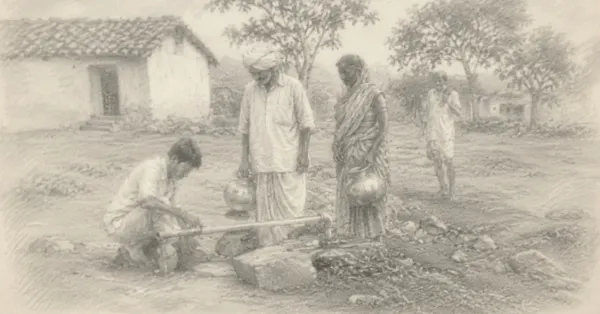
Aman saw that the village had a water problem. He contacted the authorities and motivated the villagers. Soon the problem was solved and everyone appreciated him.
It sounds positive.
But what did Aman actually do?
How did he identify the problem? Whom did he approach? What practical steps followed? What role did the other people play?
A believable PPDT story needs a visible chain:
Situation → decision → action → outcome
The action does not have to be extraordinary. It has to make sense.
Your Narration Could Have Changed the Impression
Writing the story is only one part of PPDT.
Candidates subsequently narrate their individual stories before the group and then participate in the discussion aimed at developing a common story. This basic PPDT sequence—picture, story, narration and discussion—is widely described in SSB preparation material.
This means a candidate who writes comfortably may still struggle when the same idea has to be communicated verbally.
During narration, problems often appear in simple forms:
You forget your own sequence.
You keep looking down.
You rush because you are nervous.
Your voice becomes difficult to follow.
You spend too much time explaining irrelevant background.
Or you change important elements of the story while speaking.
The objective should not be theatrical narration.
It should be clear communication.
Who was the main character? What was the situation? What did the character do? What happened?
If your listener understands that without effort, you have communicated well.
Speaking the Most in Discussion Does Not Mean Performing the Best
This is probably one of the biggest misconceptions about PPDT.
The moment discussion starts, candidates sometimes behave as though there are only two options:
dominate or disappear.
Neither is useful.
Fifteen candidates speaking at once does not become a good discussion merely because everyone is loud.
Interrupting every candidate, repeating the same point, insisting that your story must become the group story or trying to force yourself into every exchange can make your participation less constructive.
The other extreme is equally problematic.
If you remain silent throughout the discussion because others are louder, the group gets very little opportunity to see your contribution.
The better objective is straightforward:
participate meaningfully.
Introduce a useful point.
Listen.
Build on another candidate’s idea.
Correct something when necessary.
Help the group move towards agreement.
And if your own story is clearly not becoming the common story, be capable of moving forward rather than fighting to preserve it.
A group discussion is not won when your story wins.
You May Have Been Trying Too Hard to “Show Leadership”
Candidates are often told:
Initiate the GD.
Take command.
Bring everyone together.
Become the leader.
The result can be artificial behaviour.
Leadership in a group does not always mean being the first voice heard.
Sometimes the useful candidate is the one who resolves disagreement.
Sometimes it is the person who brings two similar ideas together.
Sometimes it is the candidate who speaks less frequently but brings clarity when the discussion becomes chaotic.
Trying to visibly “perform leadership” can make the behaviour look forced.
Instead of asking:
How do I show leadership?
ask:
What does this group need from me right now?
That produces much more natural participation.
Your OIR Performance May Also Be Part of the Answer
This is the point candidates often ignore after getting screened out.
They replay the PPDT discussion repeatedly:
I should have spoken one more time.
Chest No. 7 interrupted me.
My narration wasn’t perfect.
But Stage-I also includes the Officer Intelligence Rating Test.
Official guidance for NDA and CDSE selection specifically states that shortlisting is based on the combination of OIR and PPDT performance.
Therefore, you cannot reliably conclude:
“My PPDT was good, so I should have been screened in.”
You do not have the complete assessment in front of you.
Public official guidance also does not provide candidates with a simple numerical formula such as “PPDT contributes X% and OIR contributes Y%.” What it does make clear is that both form Stage-I.
So preparation for screening must treat them as one package.
“But My Story Was Better Than the Candidates Who Got Screened In”
Maybe it was.
That still does not give you their OIR performance.
You also don’t know how their overall PPDT participation was assessed.
And most importantly, you are evaluating another candidate from the position of another candidate—not from the complete assessment process.
Comparing stories immediately after the result therefore rarely tells you why you were screened out.
It usually creates more confusion.
What Should You Analyse After Getting Screened Out?
Do not ask only:
Was my story good?
Break the entire Stage-I attempt into parts.
OIR
Were you completing questions accurately under time pressure?
Did you struggle more with verbal or non-verbal reasoning?
Were you guessing excessively toward the end?
Perception
Could you identify the picture quickly?
Did your characters, mood and central situation remain consistent?
Story
Was the story connected to the picture?
Did the main character take believable action?
Was there a logical sequence rather than a manufactured positive ending?
Narration
Could you explain your story clearly within the available time?
Was the sequence easy to follow?
Discussion
Did you contribute useful ideas?
Did you listen?
Were you repeatedly interrupting?
Did you become passive when others became louder?
Could you support the group even when it moved away from your original story?
That analysis is far more useful than deciding:
“Next time I will shout louder.”
What Should You Change Before Your Next Screening?
Start with OIR.
Practise reasoning under actual time pressure instead of casually solving unlimited questions.
For PPDT, practise observing a picture briefly and committing to your perception instead of staring at it until you invent details.
Write simple, realistic stories.
Then narrate them aloud.
Record yourself occasionally. You will quickly notice whether you are rushing, repeating points or making the story unnecessarily complicated.
Most importantly, practise group discussions with people who will challenge your ideas