The Group Discussion begins.
Before the topic has even settled in everyone’s mind, one candidate starts speaking.
The Group Planning Exercise begins, and he immediately wants to present the first solution.
During an outdoor task, he rushes towards the helping materials before the group has properly examined the obstacle.
During every opportunity, the strategy remains the same:
Be first. Be visible. Take charge. Show leadership.
Many SSB candidates enter group tasks with some version of this idea. They have heard that initiative and leadership are important, so they assume the safest way to demonstrate them is to speak before everyone else.
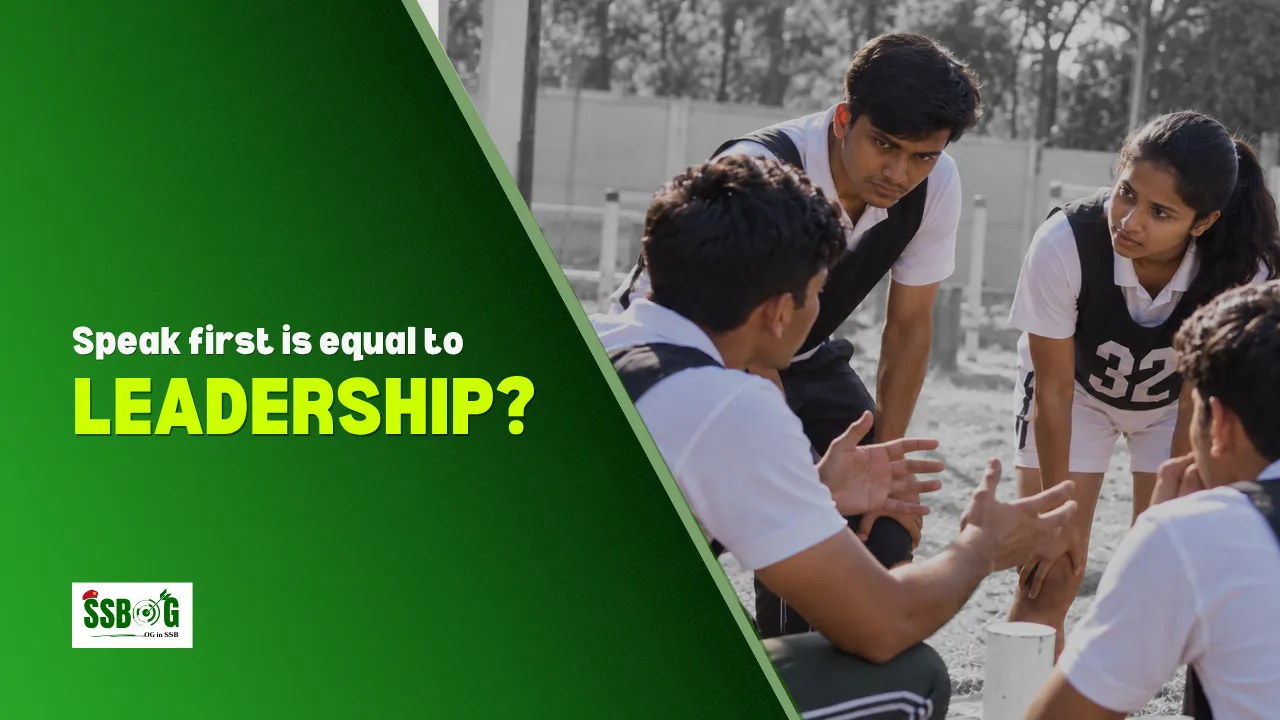
But speaking first and leading are not the same thing.
Sometimes the person who speaks first genuinely helps the group move forward.
Sometimes he simply speaks first.
The difference lies in what happens after he speaks.
Why candidates become obsessed with speaking first
The logic seems reasonable.
If I remain silent, how will the GTO notice me?
If someone else starts the discussion, won’t that person appear more confident?
If another candidate gives the first solution, won’t he get credit for initiative?
These concerns gradually turn a group task into a race for visibility.
Instead of thinking:
“What does the group need right now?”
the candidate begins thinking:
“How can I make sure I am noticed?”
That change in focus can affect behaviour.
You stop listening because you are preparing your next point.
You interrupt because you fear losing an opportunity.
You repeat an idea because you want your voice to be heard.
You rush into a task because waiting for ten seconds feels like inactivity.
You reject another candidate’s suggestion because accepting it feels like surrendering leadership.
Ironically, the attempt to constantly display leadership can make effective group behaviour more difficult.
Starting a discussion can be useful
There is nothing wrong with speaking first.
If you understand the topic, have a relevant opening and can help establish a useful direction for the discussion, starting can be valuable.
Imagine a discussion on water scarcity in Indian cities.
A candidate begins by briefly identifying population growth, groundwater depletion and inefficient urban water management as three broad areas the group could examine.
That opening gives the discussion some structure.
Now imagine another candidate who has memorised that “leaders initiate.”
The moment the topic is announced, he starts speaking even though his thoughts are not organised. He gives a generic statement, repeats the topic and then struggles to develop the argument.
Both candidates spoke first.
Their contribution was not equally useful.
Initiative has value when it moves the situation forward.
Being first is merely a sequence.
Leadership is not a speaking position
Consider what happens five minutes into a group discussion.
One candidate may have started the discussion brilliantly but has now spoken six times without allowing others to complete their points.
Another candidate did not start at all. He listened for the first minute, understood where the discussion was going, introduced a missing perspective and later helped connect two conflicting arguments.
Who demonstrated better leadership?
You cannot decide that simply by asking who spoke first.
This is the problem with turning leadership into a visible trick.
Real group situations are dynamic.
Sometimes the group needs someone to initiate.
Sometimes it needs someone to organise scattered ideas.
Sometimes it needs a candidate to introduce information everyone has overlooked.
Sometimes two people are arguing and the useful contribution is to bring the discussion back to the problem.
Sometimes somebody else already has the best idea.
In that situation, leadership may involve recognising it and helping the group execute it rather than competing to replace it with your own.
A better idea does not become worse because it came from someone else
This is especially important during GTO tasks.
Suppose your group is working on an obstacle.
You propose a solution.
Another candidate examines the structure and suggests a simpler method.
What should you do?
A candidate who is trying to look like a leader may feel pressure to defend his original idea.
He may keep explaining it.
He may try to prove why his solution is better.
He may even ignore the other candidate because accepting the suggestion feels like losing authority.
But the group’s objective is not to prove that your idea was best.
The objective is to solve the task collectively within the given conditions.
If someone else’s idea is genuinely better, recognising that quickly and helping implement it can be far more useful than protecting your own suggestion.
A simple:
“Yes, this will work better. Let’s try it this way.”
does not make you a follower.
It shows that the task matters more to you than ownership of the idea.
Leadership without cooperation quickly becomes domination.
You don’t need to lead every situation
Imagine playing football.
You may be captain of the team, but that does not mean you should take every free kick, every corner, every penalty and attempt every shot.
Different situations require different people.
Someone may be faster.
Someone may have better positioning.
Someone may understand a particular situation better than you.
Effective leadership includes recognising the abilities available within the group.
The same principle applies during SSB tasks.
You may have a strong understanding of one discussion topic and relatively limited knowledge of another.
You may identify an excellent solution during one outdoor task while another candidate sees the solution first during the next.
You may naturally take charge in a situation where you have relevant experience and play a supporting role when someone else is better positioned to guide the group.
These behaviours are not necessarily contradictory.
They can belong to the same effective group member.
Leadership does not require you to occupy the centre of every situation.
Speaking more is not the same as contributing more
Suppose Candidate A speaks eight times during a discussion.
Candidate B speaks four times.
It is tempting to conclude that Candidate A participated more effectively.
But what if four of Candidate A’s contributions merely repeat ideas already discussed?
What if he interrupts repeatedly?
What if his points are long but poorly connected to the topic?
And what if Candidate B’s four contributions introduce relevant facts, develop other people’s ideas and help the discussion progress?
Counting speaking opportunities tells us very little by itself.
This is why candidates should be cautious with advice such as:
“You must speak at least five times.”
A group discussion is not a target counter.
One meaningful contribution may sometimes be more useful than several forced ones.
That does not mean you should remain silent and expect your thoughts to be recognised.
Participation matters.
But the goal should be effective participation, not maximum airtime.
Listening is also part of group effectiveness
Candidates spend enormous amounts of time learning how to speak in GD.
Far fewer practise listening.
Yet imagine trying to work with someone who never properly listens to anybody else.
He waits for you to stop talking so that he can speak.
He repeats points because he did not hear them.
He misunderstands disagreements.
He cannot build upon another person’s idea because he is too occupied preparing his own.
Would you consider that person an effective leader simply because he speaks confidently?
Listening gives you information.
It tells you what has already been discussed.
It helps you recognise a stronger idea.
It prevents unnecessary repetition.
It allows you to understand why someone disagrees with you.
And it helps you decide when your contribution can genuinely improve the discussion.
The purpose of listening is not to become passive.
It is to make your participation more intelligent.
Leadership can appear without giving orders
Another common misconception is that leadership means directing people.
“Bring the plank.”
“You stand there.”
“Give me the rope.”
“Do this first.”
A candidate may start issuing instructions because he believes leaders are supposed to command.
But authority during a training task is not automatically created by speaking in an authoritative tone.
There is a considerable difference between helping coordinate a group and unnecessarily ordering other candidates around.
If you understand a workable solution, explain it clearly.
If someone needs assistance, help.
If the group is confused, provide direction.
If another candidate is already coordinating effectively, contribute rather than competing for control.
Leadership becomes useful when it serves the task and the group.
It becomes artificial when the candidate is primarily trying to create the appearance of authority.
Sometimes the best leadership move is to support
Suppose another candidate proposes an excellent plan during a group task.
Everyone understands it, but execution is becoming disorganised.
You can contribute by helping convert that idea into action.
You may position the helping material.
You may remind the group of an important rule.
You may help another member cross.
You may identify the next step.
You may keep the group focused when people begin trying different things simultaneously.
You did not originate the plan.
You may still contribute significantly to its success.
This is a valuable lesson beyond SSB as well.
Good teams cannot function if every member is trying to prove that he is the leader.
Sometimes you initiate.
Sometimes you coordinate.
Sometimes you execute.
Sometimes you support.
Sometimes you allow somebody else’s expertise to guide the group.
The ability to move between these roles according to the situation can be more useful than constantly trying to occupy one of them.
What if you never speak first?
There is another extreme.
After learning that speaking first is not necessary, some candidates may use this as justification for hesitation.
“I was just observing.”
“I was giving others an opportunity.”
“I prefer to speak only when I have a perfect point.”
That can become another problem.
If you consistently have useful ideas but hesitate to express them, that is worth working on.
If you wait until everyone else has spoken because you are afraid of being wrong, calling it “good listening” does not solve the issue.
The message is not:
Don’t speak first.
The message is:
Don’t speak first merely because you believe leadership requires it.
If you have something useful to initiate, initiate.
If you have something useful to contribute later, contribute then.
The timing should follow the situation rather than a memorised SSB strategy.
The same mistake appears outside GTO
This misconception can also enter TAT and the Personal Interview.
In TAT, candidates may create protagonists who lead every situation because they believe leadership must appear in every story.
A college student sees a problem and immediately forms a team.
A villager sees an issue and immediately organises the entire village.
A traveller encounters an accident and instantly becomes commander of the scene.
The story may become less realistic because the candidate is trying to insert leadership instead of responding naturally to the picture.
During the interview, the same candidate may repeatedly describe himself as a leader.
But when asked about actual experiences, he may struggle to identify situations where he genuinely influenced or coordinated people.
This brings us back to a recurring principle of SSB preparation:
Don’t manufacture qualities for the assessment. Develop experiences through which useful qualities can emerge naturally.
How do you actually improve leadership?
Not by practising how to speak first.
Take responsibility for something real.
Organise a college activity.
Coordinate a small project.
Play team sports.
Plan a trip with friends.
Volunteer for work that involves other people.
Help organise an event.
Work with people who disagree with you.
Take responsibility when your plan fails.
Allow someone else’s better idea to replace yours.
Finish work that nobody is applauding you for.
These situations teach lessons that are difficult to reproduce through lectures alone.
You begin learning when to speak.
When to listen.
When to decide.
When to ask.
When to support.
When to insist.
And when to change your mind.
That is far closer to meaningful leadership development than simply trying to become the first voice heard in every SSB task.
Stop asking “How do I show leadership?”
This may be the more important correction.
Candidates frequently ask:
“How can I show leadership in GTO?”
The wording itself reveals the problem.
You are already thinking about displaying a quality rather than solving the situation in front of you.
Try replacing that question with:
“How can I contribute effectively to this group and this task?”
That change sounds small, but it changes your focus.
You stop counting how many times you have spoken.
You stop competing to give every first idea.
You stop worrying that supporting someone else will make you invisible.
You begin paying attention to the actual problem, the people around you and what the group needs at that moment.
Sometimes that will mean speaking first.
Sometimes it will mean speaking second.
Sometimes it will mean changing the direction of the discussion ten minutes later.
And sometimes it will mean recognising that another candidate has already found the best way forward and helping make it work.
Leadership is not the art of being first. It is the ability to be useful when the situation needs you.