
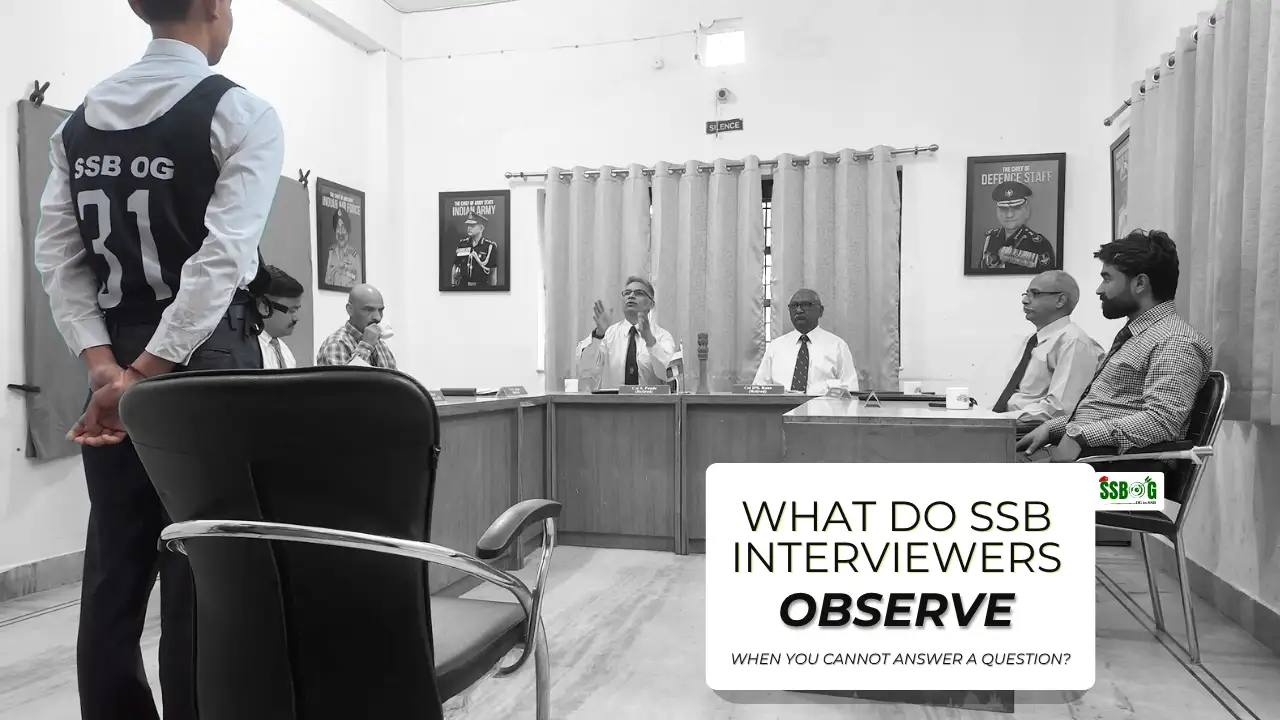
Many candidates panic when they cannot answer a question in SSB interview. Learn what SSB interviewers actually observe during such moments and why behaviour matters more than perfect answers.
The Silence After an Unknown Question Feels Longer Than It Really Is
Almost every candidate experiences this moment during SSB interview.
The Interviewing Officer asks something unexpected.
For a second, the mind searches desperately for an answer.
The room suddenly feels quieter.
Heart rate increases slightly.
And one thought appears immediately:
“What if this ruins my interview?”
Many aspirants believe the officer is mainly checking whether the answer is correct.
But in many situations, the officer is observing something deeper than knowledge.
He is observing behaviour.
Because military environments are full of uncertain moments where people may not immediately know the right answer. The important thing is how they behave during uncertainty.
What Do SSB Interviewers Observe When You Cannot Answer?
When a candidate cannot answer a question, the Interviewing Officer usually starts observing personality reactions very carefully.
He may observe:
➢ Does the candidate panic immediately?
➢ Does confidence collapse completely?
➢ Does he stay calm under discomfort?
➢ Does he try to fake knowledge?
➢ Can he admit uncertainty honestly?
➢ Does he become defensive?
➢ Can he recover naturally and continue conversation?
Interestingly, these reactions often reveal personality patterns much more clearly than memorised answers.
Why SSB Interviews Are Not Pure Knowledge Tests
Many candidates unknowingly treat the interview like a school examination.
They think:
➢ Every answer must be correct
➢ Saying “I don’t know” is dangerous
➢ Officers expect perfect knowledge
➢ One mistake may destroy recommendation
But SSB interviews are designed differently.
The Interviewing Officer is not trying to select a walking encyclopedia.
He is trying to understand:
➢ Personality
➢ Emotional balance
➢ Self-confidence
➢ Honesty
➢ Behaviour under pressure
➢ Practical thinking
➢ Communication style
Knowledge matters, but behaviour during uncertainty matters too.
Why Officers Sometimes Ask Unexpected Questions
Sometimes difficult questions are intentional.
Not to trap candidates unnecessarily, but to observe natural reactions under pressure.
Military leadership often involves situations where:
➢ Information may be incomplete
➢ Conditions may change suddenly
➢ Decisions may require calmness despite uncertainty
➢ Confidence may get challenged unexpectedly
An officer is not expected to know everything instantly.
But he is expected to remain emotionally balanced.
That is why SSB interviewers often observe reactions very carefully when candidates become uncomfortable.
Does Saying “I Don’t Know” Create a Bad Impression?
Not necessarily.
In many situations, a calm and honest response creates a much healthier impression than artificial confidence.
For example:
“Sorry sir, I am not fully aware about this.”
If spoken calmly and naturally, this often reflects:
➢ Honesty
➢ Emotional stability
➢ Self-awareness
➢ Confidence without ego
➢ Behavioural maturity
On the other hand, forced guessing often creates visible confusion.
What Happens When Candidates Try to Fake Answers
Many aspirants fear silence so much that they start speaking continuously even without clarity.
Slowly:
➢ Answers become vague
➢ Confidence starts looking forced
➢ Logic becomes inconsistent
➢ Nervousness becomes visible
➢ Behaviour loses natural flow
Experienced Interviewing Officers usually notice this quickly because they observe not only words, but emotional behaviour behind those words.
Artificial confidence often sounds unstable under pressure.
Why Calmness Matters So Much in SSB Interview
One of the strongest behavioural indicators inside SSB is emotional balance.
A candidate who remains calm during uncertain moments often appears:
➢ More reliable
➢ More mature
➢ More self-controlled
➢ More trainable
➢ More psychologically stable
Military leadership demands composure during uncomfortable situations.
That is why calm behaviour quietly creates strong impressions inside interviews.
What Interviewers Observe After You Fail to Answer
Sometimes the most important observation begins after the unanswered question.
The officer may observe:
➢ Can the candidate recover naturally?
➢ Does nervousness continue affecting performance?
➢ Does communication become shaky afterward?
➢ Can he continue conversation confidently?
➢ Does he emotionally collapse after one mistake?
Some candidates answer one question poorly and mentally lose the rest of the interview.
Others remain composed and continue interaction naturally.
That difference becomes important.
Is It Better to Guess or Admit You Don’t Know?
Blind guessing usually creates more risk than honest acceptance.
However, there is an important difference between:
➢ Thinking logically with partial knowledge
and
➢ Creating random answers to avoid silence
If a candidate genuinely knows part of the concept and explains it honestly, that may still create a healthy discussion.
But fake confidence usually becomes visible very quickly.
Interviewers interact with hundreds of candidates. Behavioural patterns become easy for them to recognise.
Why Overprepared Candidates Sometimes Struggle More
Candidates who excessively memorise interview answers often become uncomfortable when conversation moves outside prepared areas.
As soon as uncertainty appears:
➢ Communication rhythm breaks
➢ Confidence changes suddenly
➢ Facial expressions become tense
➢ Behaviour becomes unnatural
This happens because the candidate was trying to control the interview instead of participating naturally in it.
SSB interviews often become smoother when candidates focus more on authenticity than performance.
What Officer Like Qualities Become Visible During Such Moments?
Difficult or unexpected questions often reveal important Officer Like Qualities indirectly.
These include:
➢ Emotional stability
➢ Self-confidence
➢ Honesty
➢ Social adaptability
➢ Courage under pressure
➢ Behavioural consistency
➢ Maturity
Sometimes one uncertain moment reveals more about personality than several rehearsed answers.
Myth vs Reality About Wrong Answers in SSB Interview
| Myth | Reality |
| One wrong answer ruins recommendation | Overall personality matters more |
| Officers expect perfect knowledge | Officers expect balanced behaviour |
| Saying “I don’t know” looks weak | Honest responses often look mature |
| Confidence means answering everything | Confidence means staying composed |
| Interview is only about knowledge | Interview also evaluates behaviour |
How to Handle Unknown Questions Calmly in SSB Interview
Candidates usually perform better when they:
➢ Listen carefully before reacting
➢ Take a second to think calmly
➢ Avoid unnecessary panic
➢ Respond honestly
➢ Maintain natural body language
➢ Continue conversation confidently afterward
The goal is not perfection.
The goal is balanced behaviour under pressure.
Final Reality About Unknown Questions in SSB Interview
Inside SSB interview, assessors are not searching for candidates who always know the correct answer immediately.
They are searching for people who remain stable when certainty disappears.
Military leadership is rarely built on perfect knowledge all the time.
It is built on honesty, emotional balance, adaptability, calmness under pressure, and the ability to continue functioning even during uncertainty.
And sometimes, the way a candidate handles one unanswered question quietly reveals more about officer potential than many perfectly prepared responses combined.
FAQs
Is it okay to say “I don’t know” in SSB interview?
Yes. If you genuinely do not know the answer, a calm and honest response is usually better than fake or confused answers.
Do wrong answers affect SSB recommendation?
Not necessarily. SSB evaluates overall personality, emotional stability, communication, leadership qualities, and behaviour under pressure.
Why do officers ask difficult questions in SSB interview?
Difficult questions often help interviewers observe confidence, honesty, emotional balance, and reactions under uncertainty.
What should I do if I panic after not knowing an answer?
Stay calm, recover naturally, and continue the conversation confidently. One unanswered question does not define the entire interview.
What matters more in SSB interview, knowledge or behaviour?
Both matter, but behaviour, emotional stability, communication style, and officer-like qualities usually carry deeper importance during personality assessment.