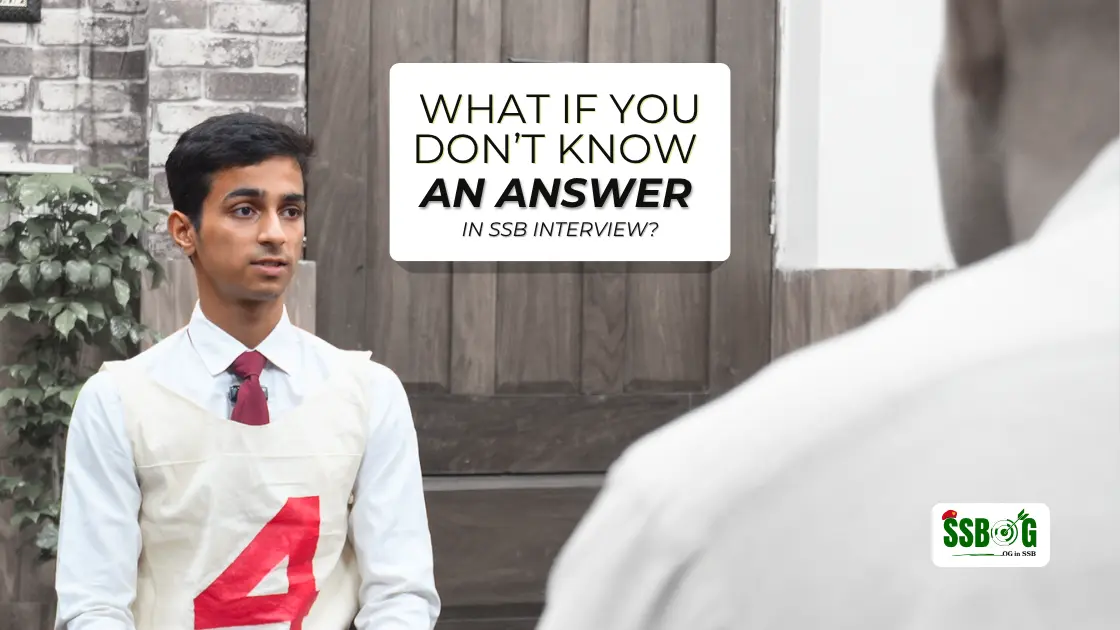
Many candidates panic when they cannot answer a question in SSB interview. Learn how assessors actually observe such situations and what matters more than giving perfect answers.
The Moment Most Candidates Fear During SSB Interview
The interview is going smoothly.
You answer a few personal questions confidently.
The conversation feels natural.
Slowly, nervousness starts reducing.
And then suddenly, the Interviewing Officer asks something you do not know.
For a few seconds, the mind goes blank.
Some candidates start panicking internally.
Some try to guess randomly.
Some begin speaking without clarity just to avoid silence.
Some become visibly nervous because they think one wrong answer may destroy their chances.
This moment is far more common than most aspirants imagine.
And interestingly, assessors are often observing your reaction more carefully than the actual answer itself.
Does Not Knowing an Answer Ruin Your SSB Interview?
No.
Not knowing every answer is completely normal in SSB interview.
The Interviewing Officer does not expect candidates to know everything.
In fact, experienced officers already understand that under pressure, even intelligent candidates may forget simple things temporarily.
What matters more is:
➢ How honestly you respond
➢ How calmly you handle uncertainty
➢ Whether you remain composed under pressure
➢ Whether you try to manipulate the situation artificially
➢ Whether your behaviour stays natural
Sometimes a calm and honest “I am not aware of this, sir” creates a much better impression than a confused attempt to fake knowledge.
Why Interviewing Officers Ask Difficult or Unexpected Questions
Many candidates think every question is asked only to test knowledge.
That is not always true.
Sometimes difficult or unexpected questions help assessors observe:
➢ Pressure handling
➢ Emotional stability
➢ Confidence under uncertainty
➢ Honesty
➢ Behavioural consistency
➢ Decision making in uncomfortable moments
Military environments often involve uncertainty.
An officer is not expected to know everything instantly.
But he is expected to remain balanced when situations become uncertain.
That is why reaction matters so much.
The Mistake Candidates Commonly Make
The biggest mistake is trying too hard to avoid saying “I don’t know.”
Some candidates start:
➢ Guessing randomly
➢ Giving half-correct information confidently
➢ Creating vague answers
➢ Changing topics unnecessarily
➢ Speaking continuously without clarity
Slowly, the answer starts sounding artificial.
And experienced Interviewing Officers usually notice this very quickly.
Because they are not only listening to words.
They are observing behaviour.
Why Honest Candidates Often Leave Better Impressions
Inside SSB, honesty usually feels visible.
A candidate who calmly accepts uncertainty often appears:
➢ More emotionally stable
➢ More self-aware
➢ More genuine
➢ More confident internally
➢ Less insecure about judgment
On the other hand, candidates trying too hard to appear perfect sometimes create visible tension in their behaviour.
The interview slowly stops feeling natural.
Instead of conversation, it starts feeling like performance.
What Assessors Actually Observe in Such Situations
When a candidate cannot answer something, assessors often observe:
➢ Does the candidate panic?
➢ Does he become defensive?
➢ Does he stay respectful?
➢ Can he accept limitations calmly?
➢ Does he try to fake knowledge?
➢ Does confidence collapse completely?
➢ Can he recover naturally and continue conversation?
These reactions reveal personality patterns much more deeply than memorised answers.
One Honest Response Is Better Than Five Artificial Ones
Imagine two candidates.
Candidate 1
He does not know the answer but keeps guessing continuously to avoid admitting uncertainty.
Slowly:
➢ Answers become inconsistent
➢ Confidence starts looking forced
➢ Communication loses clarity
➢ Nervousness becomes visible
Candidate 2
He listens carefully and replies calmly:
“Sorry sir, I am not fully aware about this.”
Then he remains composed and continues interaction naturally.
Very often, Candidate 2 creates a more mature impression.
Because emotional balance under pressure matters heavily in SSB.
Does the Interviewing Officer Intentionally Create Pressure?
Sometimes yes.
Not to frighten candidates unnecessarily, but to observe natural behaviour during discomfort.
Military leadership involves situations where:
➢ Information may be incomplete
➢ Decisions may feel uncertain
➢ Pressure may increase suddenly
➢ Confidence may get challenged
That is why interview behaviour matters more than scripted perfection.
A candidate who stays balanced during uncomfortable moments often appears more reliable.
Why Candidates Become Overly Afraid of Mistakes
Many aspirants enter SSB believing:
“One wrong answer can end everything.”
This mindset creates unnecessary pressure.
As a result:
➢ Thinking becomes rigid
➢ Communication becomes unnatural
➢ Anxiety increases
➢ Candidates stop listening properly
➢ Fear of judgment becomes visible
But SSB is not searching for perfect human beings.
It is searching for personalities with maturity, adaptability, and leadership potential.
What You Should Actually Do If You Don’t Know an Answer
Stay Calm
The moment becomes much worse when candidates panic internally.
Take a second.
Listen carefully.
Respond naturally.
Be Honest
If you genuinely do not know something, accept it respectfully.
Simple honesty usually feels more mature than forced intelligence.
Do Not Over-Explain
Some candidates keep talking unnecessarily after admitting they do not know.
That often increases confusion.
A calm and brief response usually works better.
Recover Naturally
One unanswered question does not define the interview.
Many candidates answer one question poorly and then mentally collapse for the remaining interaction.
Good candidates recover quickly and continue conversation with balance.
The Difference Between Confidence and Ego in SSB Interview
Confident candidates accept uncertainty without emotional collapse.
Ego-driven candidates feel uncomfortable admitting limitations.
That difference becomes visible during interviews.
Real confidence often sounds calm.
Artificial confidence usually becomes defensive under pressure.
Myth vs Reality About Wrong Answers in SSB Interview
| Myth | Reality |
| One wrong answer ruins recommendation | Overall personality matters more |
| Officers expect perfect knowledge | Officers expect balanced behaviour |
| Saying “I don’t know” is weakness | Honest responses often appear mature |
| Confidence means answering everything | Confidence means staying composed |
| Interview is only knowledge testing | Interview heavily evaluates behaviour |
What Officer Like Qualities Become Visible During Such Moments
Interestingly, difficult questions often reveal important Officer Like Qualities.
These include:
➢ Emotional stability
➢ Self-confidence
➢ Honesty
➢ Social adaptability
➢ Calmness under pressure
➢ Maturity
➢ Behavioural consistency
That is why reaction matters so much during uncertain moments.
Final Reality About Not Knowing Answers in SSB
Inside SSB interview, assessors are not searching for candidates who know everything.
They are searching for candidates who remain balanced when they do not know everything.
Military leadership is not built on perfect answers all the time.
It is built on honesty, emotional control, practical thinking, and the ability to stay composed under pressure.
And sometimes, the way a candidate handles one uncertain moment quietly reveals more about personality than ten perfectly memorised answers.
FAQs
Is it okay to say “I don’t know” in SSB interview?
Yes. If you genuinely do not know the answer, a calm and honest response is usually better than guessing incorrectly or creating artificial answers.
Do wrong answers affect SSB recommendation?
Not necessarily. SSB evaluates overall personality, behaviour, emotional balance, and officer-like qualities rather than isolated mistakes.
Do Interviewing Officers intentionally ask difficult questions?
Sometimes yes. Difficult questions often help assessors observe confidence, honesty, pressure handling, and behavioural consistency.
How should I respond if I do not know an answer?
Stay calm, respond honestly, avoid unnecessary explanations, and continue the conversation naturally.
What matters more in SSB interview, knowledge or behaviour?
Both matter, but behaviour, personality, emotional stability, and communication under pressure often carry deeper importance during assessment.